Estimate Measurements Without a Calculator — Easy
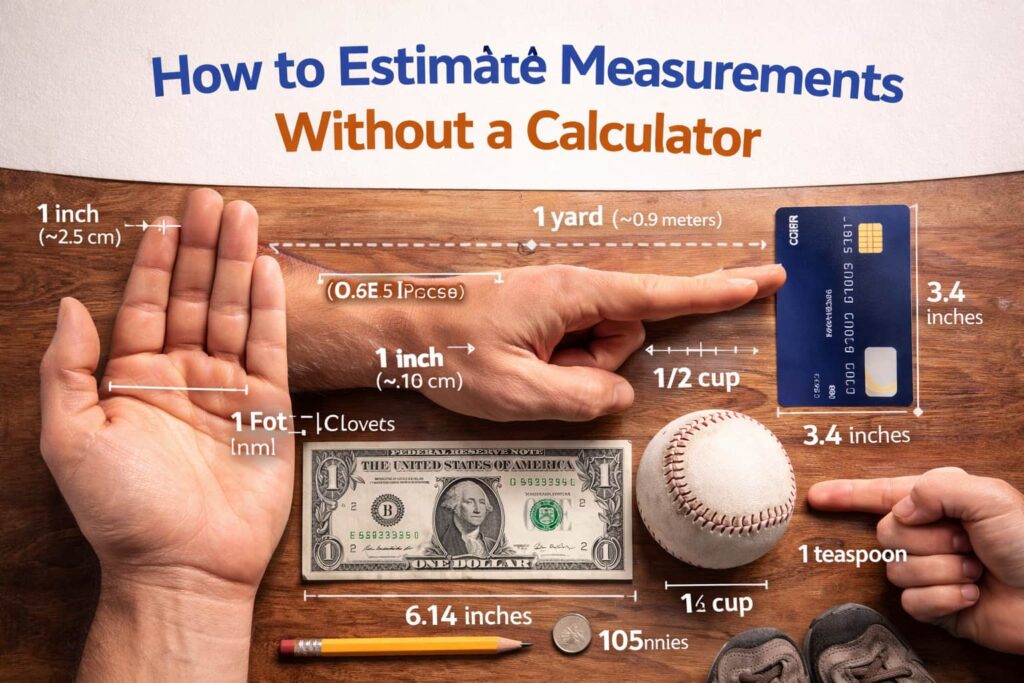
How to Estimate Measurements Without a Calculator By the calchub.tech team Over the years, while building, testing, and validating tools, we have learned that estimating measurements without a calculator is not guessing. It is a practical skill based on observation, repetition, and using built-in reference points from your own body and everyday objects. Many people already do this without realizing it, especially in daily tasks. Quick Kitchen Estimates When cooking and you lack tools, estimating kitchen measurements becomes easier if you rely on visual approximations of volume. From our own testing at home and while preparing recipe-related guides, these comparisons stay consistent enough for everyday use. 1 cup is roughly the size of a baseball or a closed fist.1/2 cup is approximately the size of a tennis ball.1 tablespoon is about the size of an ice cube or the tip of your thumb.1 teaspoon is close to the tip of your index finger. After repeating this a few times, your eyes begin to recognize these amounts faster than reaching for a measuring cup. Body-Based Length Checks For estimating length and estimating distance, personal anatomy works as a reliable manual ruler. From measuring layouts and rough plans, we have found that knowing your standard dimensions makes quick checks possible almost anywhere. 1 inch, or about 2.5 cm, is roughly the distance from your thumb tip to the first knuckle.4 inches, or about 10 cm, is the average width of a closed palm across the knuckles.1 foot, or 12 inches, is close to the long side of standard U.S. letter paper (8.5 x 11 inches), just shy of a foot.1 yard, or about 0.9 meters, is the distance from your nose to the tip of your outstretched finger when you look straight ahead. For longer distances, movement helps. An average adult’s natural step or stride is roughly 2.5 feet to 3 feet. Counting paces works well, and 10 paces usually measure approximately 25 feet to 30 feet, which is accurate enough for most everyday needs. if you think doing measurement manually is not easy for you then we have wide list of calculator on hub page please visit Fast Mental Conversions When mental math is needed, simple conversion shortcuts help with converting between units, especially from metric to imperial. Rounded numbers make quick mental math easier and faster. To convert kilometers to miles, multiply by 0.6. For example, 10 km is about 6 miles.To convert kilograms to pounds, multiply by 2.2. A fast method is to double the number and then add 10 percent. For example, 50 kg doubled is 100, plus 10 makes 110 lbs.To convert centimeters to inches, divide by 2.5. For example, 10 cm divided by 2.5 equals 4 inches. These shortcuts are commonly referenced in measurement research and engineering education, including standards published by the U.S. National Institute of Standards and Technology:https://www.nist.gov/pml/owm/metric-si/si-units Objects You Already Carry When body references are not enough, everyday reference objects help. Standardized items from your wallet or around the house can act as backup rulers, something we often rely on during quick checks. A dollar bill is exactly 6.14 inches long and 2.61 inches wide.A credit card has a standard size of roughly 3.4 inches by 2.1 inches.A U.S. quarter is just under 1 inch in diameter, measuring about 0.955 inches. Because these objects are manufactured to fixed standards, they remain reliable across different situations.